The Susquehanna River valley on a bright sunny day, with forested Appalachian ridges and a small Pennsylvania town nestled in the valley below.
A proposal · Lycoming County, PA

They want our power.
Here’s what it costs them.

Pennsylvania exempts data-center equipment from local property tax and state sales tax. That is the rule. So the property-tax benefit of a hyperscale campus in Lycoming is modest — on the order of $2–7 million a year for a 300 MW project, mostly to the school district. The deal is only worth it if the community insists on three things, in writing, before any approval: full taxation with no abatement, a binding requirement that the developer pay 100% of its own grid and water costs, and an aggressive Community Benefit Agreement tied to total project investment. Demand all three. Or decline the project.

What the host community takes home

A 300 MW campus, on Lycoming’s terms.

Under Pennsylvania law, the bulk of these commitments cannot live in zoning — they live in a separate, binding Community Benefit Agreement (CBA) executed before any conditional-use or land-development approval. The CBA is contractual, given in exchange for the community’s support on a discretionary approval. The community’s leverage is the moratorium and the discretionary permit. Walk away from any of these terms and the project doesn’t get the support it needs to get built.

$10M+
per year, recurring · CBA + property tax
PA exempts data-center equipment from local tax. The taxable base is land plus building shell — roughly $2–7 million/yr in property tax for a 300 MW campus, mostly to the school district. The remaining value is captured through the CBA: a $25,000 / MW / yr opening recurring package, plus a one-time community trust at 1.5% of total project capex. Escalated annually. No abatement. Source: 53 Pa.C.S. § 8811(b); Lycoming County 2025 millage.
$20M
up-front community trust
1% of gross capex, seeded at construction commencement. Held by the First Community Foundation Partnership of PA, governed by a board where the developer is a minority voice.
$25,000
per MW, per year, opening CBA position
Negotiated host community + school + emergency-services + ratepayer-relief + monitoring fees in the CBA term sheet. For a 300 MW campus, that is $7.5 million a year in recurring CBA revenue. Opening negotiating position, not a market rate. Escalated 3% / yr with a CPI floor. Disclosure of contracted MW load is a condition precedent.
100%
of property tax, no abatement
Developers will ask for a LERTA abatement. The ordinance and the CBA both say no. The developer pays the full assessed property tax on land and shell from day one — no discount, no phase-in. A municipality cannot compel a private taxpayer into a PILOT through zoning (PA Uniformity Clause, Art. VIII § 1), so the dollar commitments live in the CBA instead.
$2M
Penn College endowment + $300k/yr
One-time endowment to stand up a Data Center Operations & Mechatronics track at Penn College, plus $300k/yr recurring for full tuition for a defined cohort of Lycoming and Clinton County residents, paid apprenticeships during build-out, and a guaranteed interview at the host facility. Our kids stay home.
4 strands
dark fiber to every anchor
Township hall, fire/EMS station, public school, and a designated rural anchor each get gigabit-grade dark fiber, extended at cost, with transport billed at the regulated wholesale rate.
$250k
per facility, per year, to IPT
Williamsport Regional Airport restoration fund — a dedicated CBA line item, modeled on the existing Surf Air community sponsorship at IPT.
125%
demolition bond, CPI-escalated
No bond, no permit. Re-estimated every five years. Change-of-control triggers a successor bond within 60 days. The county is never left holding a hollowed-out warehouse.

Plus: a fully-equipped Class A pumper and lithium-fire response trailer for the host VFC; annual specialized training at developer expense; a public real-time dashboard for noise, water, and energy use; and an adaptive-reuse first-option clause that gives the buildings a second life. The CBA is the binding mechanism. Read the full Community Benefit Agreement term sheet →

What is actually on the table

This is not hypothetical. Two campuses are already in motion within twenty miles of each other.

A 300 MW reference campus is not a thought experiment in Lycoming County. As of mid-2026, two distinct hyperscale data-center proposals sit on local desks, and the transmission line to feed one of them is already running its routing process. The only open question is whether they get built on the host community’s terms or the developer’s.

In our county

Muncy Township — West Branch Susquehanna site

  • Three data center buildings, roughly 699,574 sq ft total, plus water tanks, treatment, substation, and security building.
  • Parcel along John Brady Drive near Yetter Road — about two miles east of the closed Lycoming Mall, near the West Branch of the Susquehanna.
  • Zoning application dated April 15, 2026. The township responded by enacting a nine-month moratorium while it drafts data-center zoning regulations.
  • Filed by DANKO Holdings II LP / Fishlips LLC, an arm of The Liberty Group (Daniel Klingerman) — a regional Williamsport-area developer. The project’s engineering firm has affiliation with Pennsylvania Data Center Partners, but that is an engineering overlap, not the applicant’s identity.
  • Contracted IT load (MW), end user, and parent guarantee are not yet disclosed. Disclosure of all three should be a condition precedent before any conditional-use or land-development approval.
  • Water and sewer arrangements: to be determined, per the Lycoming County Water and Sewer Authority.

Sources: Sun-Gazette — site plan details (June 10, 2026); Sun-Gazette — initial reporting (June 8, 2026); northcentralpa.com Muncy coverage.

Just over the line

Gregg Township, Union County — Great Stream Commons

  • Up to four data centers, ~1.5 million sq ft of development, delivering up to 300 MW of capacity.
  • Located in Great Stream Commons, just north of Allenwood — immediately across the county line from Lycoming.
  • Phase 1 retrofits an existing ~500,000 sq ft warehouse (planned 2027); Phases 2–4 in new construction beginning 2029.
  • Includes an on-site 69 kV substation and a closed-loop water system.
  • Developer-pledged community contributions: a new fire engine and a $2 million community fund. Zoning amendment hearing scheduled May 4, 2026.

Sources: Allenwood project disclosure (developer); The Express — Union County business park (April 4, 2026).

The transmission picture

PPL Electric — 9 miles of new 230 kV between Allenwood and Elimsport

  • Five candidate routes under study, each up to nine miles long, running between Allenwood and Elimsport.
  • 230 kV transmission on steel towers averaging 140 ft tall (range 90–180 ft), spaced 200–1,000 ft apart.
  • New substation, switchyard, access roads, and tree clearing through privately-owned farmland.
  • The cost-bearing mechanism is now codified. The PA PUC issued its large-load tariff Final Order in Docket M-2025-3054271 on May 12, 2026, and PPL’s March 2026 rate-case settlement created a separate large-load data-center rate class. Together, those require the developer to bear interconnection and grid-upgrade costs that serve its load.
  • Caveat: the PPL settlement still raised average residential rates by about 4.9%. Residents do bear some grid-wide cost from data-center growth across PJM, even when project-specific interconnect costs are walled off. This is why the CBA includes a Ratepayer Relief Fund.
  • Public siting comment goes to [email protected].

Sources: PA PUC Final Order, Docket M-2025-3054271 (May 12, 2026); WHYY — PPL rate-case settlement (March 2026); Sun-Gazette — routing meeting coverage (June 9, 2026).

The point: the projects, the substations, and the transmission corridors are not theoretical. The only variable left is what each host community asks for in writing before the buildings go up. This ordinance is what we are asking for.

How this ordinance goes further

Where the typical model ordinance stops, this one starts.

The 2026 PA DEP Citizens Advisory Council guide and most county-level templates were drafted to be politically palatable to developers. Useful as a baseline. Insufficient as a deal. Lycoming’s ordinance pulls the same structural bones and then sharpens every clause where the host community has actual leverage.

Provision
Typical model ordinance
Lycoming’s ordinance
Setback from sensitive receptors
40–300 ft, often property-line only
1,000 ft from residences, schools, hospitals, daycares, and places of worship — floor of 250 ft on all lines
Overnight noise cap
Usually silent or deferred to general nuisance code
40 dB(A) / 50 dB(C) at the property line, 7 pm–7 am, with pre-construction and post-occupancy verification
Cooling water
Encouraged to study impacts; no hard limits
Closed-loop required unless an alternative uses less water and less energy; 1-mile hydrogeologic study; PADEP/SRBC permits; drought-response plan
Backup generation
Diesel; emissions per state air permit
Lean-burn natural gas primary, on firm-contract Marcellus pipeline supply. Diesel allowed only as last-resort, capped at 20% of backup capacity and 72 hours of fuel
Tax treatment
LERTA abatement frequently granted
No abatement. Fixed PILOT at ≥ 80% of full-build tax, paid from construction commencement, escalated, with statutory split: 60% schools / 30% township / 10% county
Community benefit
“Voluntary” or aspirational language
1% of gross capex into a trust at construction commencement, citizen-majority board, published disbursement plan — plus host fee, BPT, airport fund, fire-services impact contribution, dark fiber, and Penn College endowment as conditions of approval
Workforce
“Local hiring preference” (unenforceable)
Endowed Penn College track, paid apprenticeships, guaranteed first interview, dual-enrollment cloud-computing curriculum — baked into the host agreement
Decommissioning
Demo bond, sometimes 100% of estimated cost
125% bond, CPI-escalated, third-party re-estimated every five years, change-of-control triggers successor bond in 60 days, regulated materials out within 180 days, adaptive reuse as first option
Emergency services
Coordination with local fire/EMS encouraged
Capital contribution per MW + annual operations payment; developer-funded radio coverage (BDA/DAS) where needed; annual specialized training paid for the life of the facility
Transparency
Annual report to the municipality (sometimes)
Public real-time dashboard for noise, water draw, and energy use — updated continuously, accessible to any resident

None of these provisions kill the project economics. Hyperscalers routinely build under stricter regimes in northern Virginia, Ireland, and Singapore. What this ordinance does is make sure the value created in the valley stays in the valley.

The case

Lycoming County isn’t doing fine. It’s on the brink.

The 2026 county budget opened with a $23 million structural deficit. Commissioners closed it by cutting $28 million over two years, drawing the fund balance down to roughly $10 million (the state recommends three months of operating reserves), and approving the first county tax hike since 2018. Williamsport’s police bureau is running 50 officers doing the work of 68–70, and the city moved its 250th-anniversary Fourth of July fireworks out of downtown because public safety couldn’t staff the event. PFM projects the city itself faces a $3–5.1 million deficit in 2026 if it does nothing. This is the cash-flow reality of a county that has run out of cuts. Property tax alone won’t fix it — PA exempts the equipment, the school district is the main beneficiary of what tax there is, and the county receives only about 27% of any property-tax bill. The case for a data center here rests on the CBA, not the tax line.

$61k
Median household income
vs. ~$75k Pennsylvania statewide (FRED, 2024)
−8%pop
Population since 2000
Continued out-migration of working-age adults (Census / WPR)
829MW
Local gas-fired generation already on-site
Panda Patriot combined-cycle plant in Clinton Township, PJM-connected (EIA Form 860). Serving an adjacent private load behind the meter is contested at FERC — this plant supports the regional grid, not a guaranteed plug-in for the project.
$2–7M
Real-estate tax per 300 MW campus, per year
PA exempts data-center equipment from local property tax (53 Pa.C.S. § 8811(b)). Taxable value is land + shell only. Combined Muncy Township rate is 26.22 mills on assessed value (CLR ~51%), so effective rate on market value is ~1.3% (Lycoming County 2025 millage). Most of this revenue goes to the school district. The real local upside comes from the CBA.
The honest cost

Your electric bill is going up because of data-center load — everywhere on PJM.

PJM’s most recent capacity auction cleared at the price cap. Residential bills across Pennsylvania are up double-digit percentages, and electricity shutoffs are climbing. Any honest case for hosting a data center has to address this first — not as a talking point, as a contract term.

$29 → $333
PJM capacity price, per MW-day
2024/25 to 2025/26 auction, hit the price cap.
+$1B
PA generation cost increase
Estimated 2025-2026 incremental cost to Pennsylvania ratepayers from the PJM capacity-price jump.
10–20%
Residential bill increases
PPL’s March 2026 rate-case settlement alone raised residential rates by ~4.9%, on top of supply-side increases.
+21%
Electricity shutoffs, PA
Year-over-year increase in residential electricity shutoffs across the Commonwealth.

The protections that have to be in place before the project is worth hosting.

  1. PA PUC large-load tariff (Final Order, Docket M-2025-3054271, May 12, 2026): requires large new loads to bear interconnection and grid-upgrade costs that serve them, rather than socializing the cost across all ratepayers.
  2. PPL rate-case settlement (March 2026): creates a separate large-load data-center rate class, so this facility’s capacity charges are not blended into residential and small-business bills. Caveat: the same settlement still raised average residential rates ~4.9% to recover other grid investment.
  3. The CBA Ratepayer Relief and Weatherization Fund: $3,000 / MW / yr from the developer, county-administered, paid as bill credits to low- and moderate-income residential customers and as efficiency retrofits in the host community.
  4. SRBC consumptive-use permit and one-mile hydrogeologic study filed before any approval, and a hard annual cap on consumptive water use with overage penalties.
  5. Governor Shapiro’s GRID Standards (May 27, 2026): condition the Act 25 equipment exemption on community-benefit and full energy cost-bearing commitments.

Without all five, the project asks the community to absorb higher power bills, water draw, truck traffic, and lost rural character for a township tax share on the order of $150,000 a year. At that point the right answer is to decline the project.

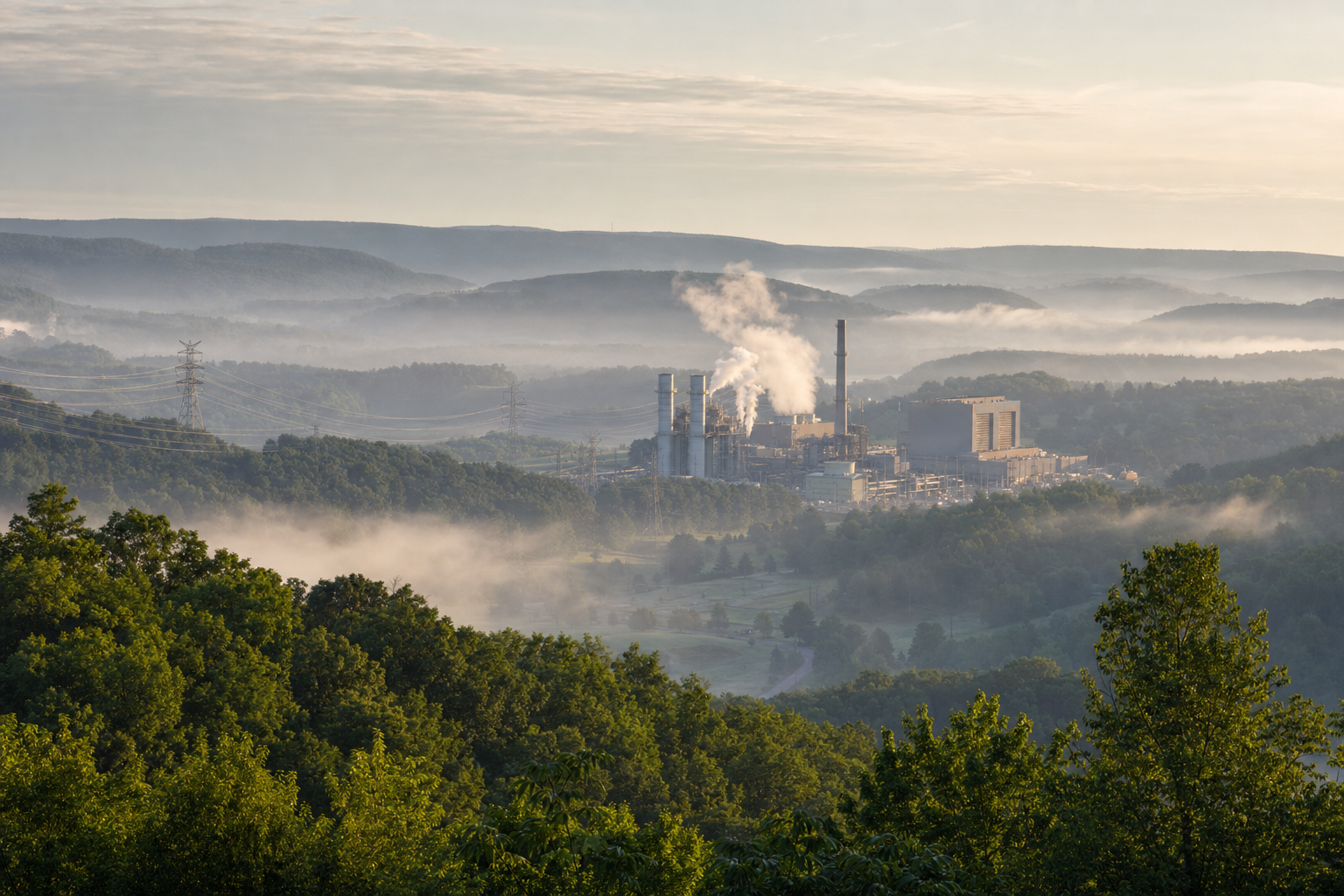
Wide-angle view of the Panda Patriot natural-gas combined-cycle power plant in Clinton Township, Lycoming County, with the West Branch Susquehanna River winding through the village of Montgomery, PA, and forested Allegheny Plateau ridges behind it on a bright sunny day.
Why here, why now

Five advantages most counties would kill for.

Hyperscalers are not looking for the cheapest land. They’re looking for the rare combination of cheap, reliable power within transmission distance, sufficient water, a workforce that won’t flee, and a county government that can issue a permit before the project economics rot. Lycoming has all five.

Near existing generation and transmission

The 829 MW Panda Patriot combined-cycle plant in Clinton Township is connected to PJM, and PPL is studying a new 230 kV line through the area. Siting adjacent to existing generation and transmission is a real cost advantage. It is not, however, plug-in-ready power. Behind-the-meter co-location of a private load with a merchant generator that sells into PJM is contested at FERC — see the Talen-Amazon arrangement at Susquehanna. Treat “power on the property line” as “power on the regional grid we can connect to under tariff,” not as a guaranteed bypass.

Water with strict standards

The West Branch of the Susquehanna passes through the county at sustained flows. The community’s leverage here is not the river — it is the regulator. The Susquehanna River Basin Commission must permit any consumptive use, and the CBA requires closed-loop cooling by default, a 1-mile-radius hydrogeologic study, and a drought-response plan as conditions precedent. Examples of water management going wrong — Morrow County, Oregon’s nitrate crisis among them — are why these conditions are non-negotiable.

A workforce already trained in heavy industry

Pennsylvania College of Technology graduates electricians, HVAC technicians, mechatronics engineers, and welders by the thousand — most of them currently leaving for jobs out of state. A 300 MW data-center campus typically needs roughly 1–2 operations staff per MW permanently (150–300 jobs) in operations, security, and maintenance, at wages that compete with Marcellus drilling, plus several times that during the multi-year construction phase. The endowed Penn College track in the CBA turns that headcount into a local pipeline.

Geology that costs less to build on

The ridge-and-valley topography of north central PA gives developers what coastal sites can’t: rock at shallow depth, low seismic risk, no flood-plain federalism, no hurricane insurance premium. Construction costs run 20–30% below the Virginia data-center alley average.

State policy: read it accurately

Pennsylvania’s Act 25 of 2021 Computer Data Center Equipment Exemption Program waives state sales tax on servers, cooling, and software for projects investing ≥$75M and creating ≥25 jobs. The PA Department of Revenue projects the exemption will cost the state over $517M per year by FY2030-31, and Governor Shapiro’s GRID Standards (May 27, 2026) now condition the exemption on community-benefit and full energy cost-bearing commitments. HB 2151 passed the PA House 124–77 in April 2026 (not law yet) — backed by Food & Water Watch and PennFuture, it is a community-protection bill directing DCED to publish a model ordinance to help municipalities regulate data centers. Frame it as the community’s leverage, not a developer green light.

A 300 MW data-center campus in Muncy Township generates roughly $2–7 million per year in local property tax — modest, because PA exempts the equipment that is most of the project cost. But it sends zero new students to the school district, and a signed CBA can add another $7–10 million per year in dedicated host-fee, school, ratepayer-relief, and emergency-services revenue. The CBA is where the real money is.
Modeling the Muncy filing against 53 Pa.C.S. § 8811(b) and the 2025 Lycoming County combined millage of 26.22 mills
The model ordinance

Seven pillars. One ordinance. Ready to vote.

The Pennsylvania DEP Citizens Advisory Council published a Data Center Ordinance Guide in 2026 — a 30-page toolkit municipalities can copy almost verbatim. Below is a synthesis of its core provisions, tuned for Lycoming County conditions. Every number is defensible. Every standard is enforceable. Read the full ordinance text →

Pillar 01

Siting & setbacks

Permit data centers only in I‑1 / I‑2 industrial districts with a minimum 5‑acre lot for any facility exceeding 100,000 sq ft. Require 1,000 feet of separation from any residential use or sensitive receptor, reducible to 500–999 feet only if the applicant exceeds ambient‑noise and visual‑screening standards.

Threshold: 100,000 sq ft · Setback floor: 250 ft all property lines
Pillar 02

Noise that protects sleep

Cap sound at the property line at 40 dB(A) / 50 dB(C) overnight (7 pm–7 am) and 45 dB(A) / 60 dB(C) during the day. Require pre-construction and post-occupancy noise studies, conducted between one and twelve months after the first Certificate of Occupancy.

Night limit: 40 dB(A) · Gas-primary generators
Pillar 03

Closed‑loop water by default

Require closed-loop cooling unless an alternative demonstrably uses less water and less energy. Prohibit private wells or stream withdrawals as a primary cooling source when public water is available. Require a 1-mile-radius hydrogeologic study, drought response plan, and PADEP / SRBC permits before approval.

Cooling: Closed-loop · Study radius: 1 mile
Pillar 04

Backup power, on Marcellus gas

Primary backup generators shall be lean-burn natural gas, fueled via firm-contract Marcellus pipeline supply — not diesel. Gas engines meet EPA Tier 4 without aftertreatment, cut NOx and particulates dramatically, and run on the fuel we already produce. Diesel is permitted only as a fuel-of-last-resort for pipeline outages, capped at 20% of backup capacity and 72 hours of on-site fuel. No peak shaving. No grid arbitrage. Annual emissions reports to the municipality.

Primary fuel: Natural gas · Diesel: last-resort only
Pillar 05

Full taxation, no abatement

Developers will ask for a LERTA abatement. The community refuses, and refuses any PILOT discount as well. The developer pays the full assessed property tax on land and building shell from day one. PA exempts the equipment (53 Pa.C.S. § 8811(b) plus Act 25 of 2021), which is most of the project cost. So real-estate tax on a 300 MW campus runs roughly $2–7 million a year on land plus shell at Muncy’s combined 26.22 mill rate. The dollar commitments that capture fair value of the otherwise untaxable equipment live in the Community Benefit Agreement — not in zoning. A municipality cannot compel a private taxpayer into a special data-center tax (PA Constitution Art. VIII § 1, Uniformity Clause). The CBA is contractual, given in exchange for community support on a discretionary approval.

Property tax: ~$2–7M / yr / 300 MW · CBA recurring: ~$7–10M / yr
Pillar 06

Reuse first, demolition bonded

Require a financial surety equal to 125% of demolition and site-restoration cost, CPI-escalated. If data-center use ends, the owner has 12 months to either pursue a permitted reuse, market the property as industrial reuse, or begin decommissioning. Regulated materials (refrigerants, batteries, fuels) come out within 180 days regardless. Buildings worth keeping can stay. No bond, no permit.

Bond: 125% demo cost · First option: Adaptive reuse
Pillar 07

The CBA is the deal

Under the PA Municipalities Planning Code, a Community Benefit Agreement cannot be written into zoning — it is a separate, binding contract executed before any conditional-use or land-development approval, given in exchange for the community’s support on a discretionary permit. The CBA term sheet sets opening positions on host community fee, supplemental school payment, ratepayer-relief fund, emergency-services operations and capital, environmental monitoring, Penn College endowment, an up-front community trust at 1.5% of total project capex, dark fiber to municipal anchors, water and noise standards, decommissioning bond, and a most-favored-community clause. No CBA, no community support. No community support, no permit.

Vehicle: Binding contract · Executed: Pre-approval
The economics

What a 300 MW campus actually does to a county’s books.

Compare the fiscal footprint of one mid-sized hyperscale campus against the most-typical alternative development scenarios. The data center costs the county close to zero in new services — no school enrollment, marginal road wear, no expansion of social services. The local revenue is modest on property tax (PA exempts the equipment) but substantial through the Community Benefit Agreement, which is what the community actually negotiates for.

Per project, 7-year horizon
300-home subdivision
300 MW data center
Local property tax over 7 years
~$5.5M
~$14–49M
CBA recurring + one-time, 7 years
$0
~$80–125M
New students into school district
~180
0
Permanent jobs created
~12
150–300
Construction-phase jobs
~120
1,500–2,500
Daily traffic generated
~2,400 trips
~600 trips
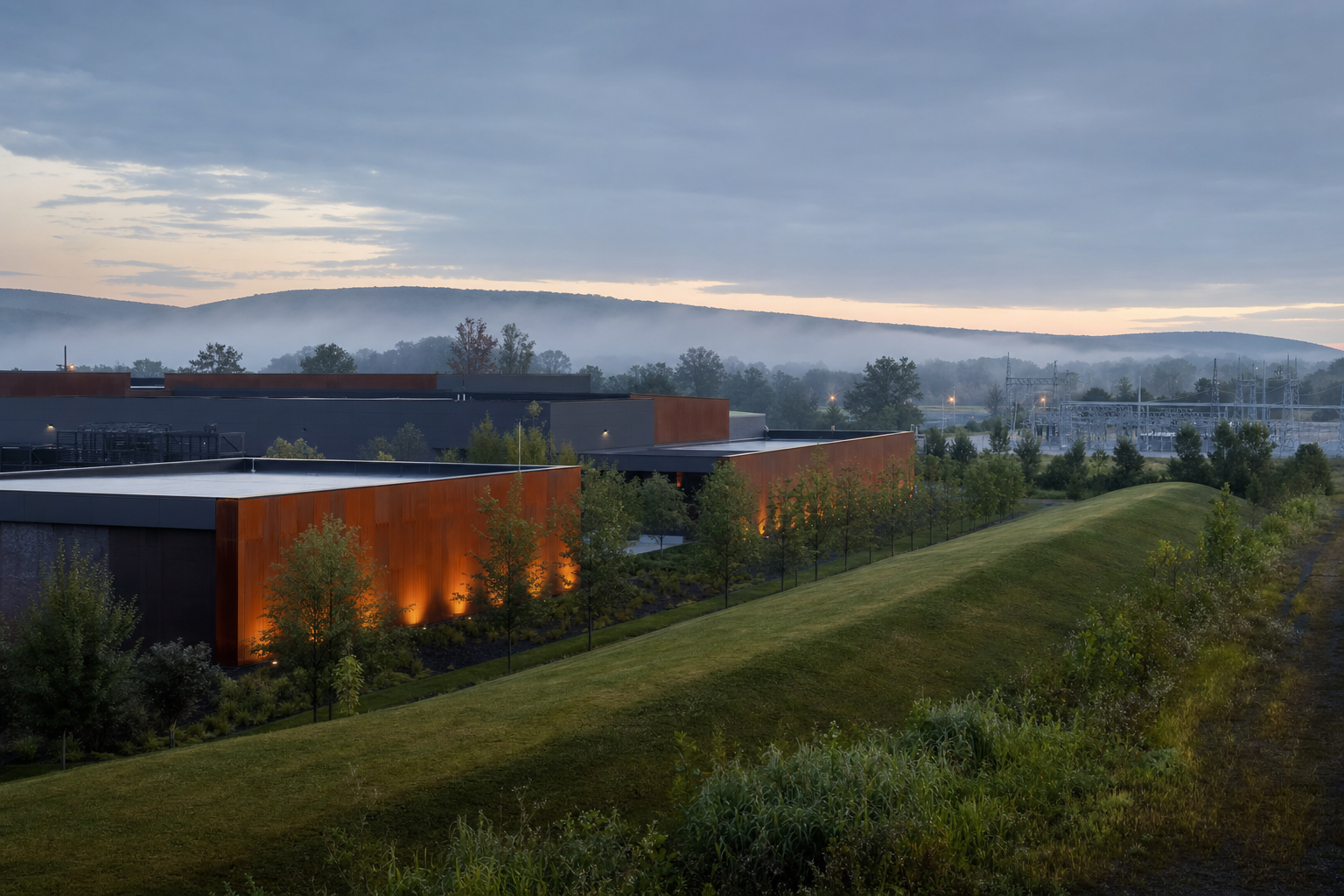
A modern data center campus clad in weathered steel, integrated into a rural Pennsylvania landscape with mature trees and a grass berm screening the facility.
The local dividend

If a hyperscaler wants to plug into our grid, it pays our bills.

Opposition to data centers is loud right now — in Bucks County, in northern Virginia, in Memphis — and the reason is almost always the same: residents see the wires going in and don’t see anything coming back. Lycoming’s ordinance answers that objection on page one. Every megawatt of approved load triggers a stack of legally enforceable obligations to the host township, the county, the school district, and the airport. This is not a wish list. Every mechanism below is permitted under existing Pennsylvania statutes and has been used somewhere in the Commonwealth or in a peer state.

01

Host Community Fee — $3,500 per MW per year

A 300 MW campus pays the host township $1.05M/year in unrestricted general-fund revenue — escalated 2.5% annually, paid quarterly, not abated. For most host townships of this size, that single line item is on the order of an entire annual general-fund budget.

02

Full property tax, no abatement

Developers will ask for a LERTA tax abatement — NorthPoint already did exactly that in Luzerne County. The community refuses. Full assessed property tax on land and shell, day one, no phase-in. PA exempts the equipment, so that yields roughly $2–7 million/yr for a 300 MW campus. About 64% of any property-tax bill in Muncy goes to the school district, 27% to the county, and 9.5% to the township. The dollar commitments that capture fair value of the otherwise untaxable equipment live in the CBA, which is a separate contract.

03

Business Privilege Tax on gross receipts

Data centers are a service business under Pennsylvania law — they sell compute, storage, and bandwidth — which means they are not shielded by the manufacturing exemption that protects Marcellus producers. The host township levies BPT at 1.5 mills on in-jurisdiction gross receipts. On a $400M-revenue tenant, that is $600,000/year the township keeps.

04

Airport Restoration Fund — $250,000 per facility per year

Williamsport Regional Airport lost American Airlines and is now served by a single 9-seat Cessna Caravan operated by Southern Airways Express to Dulles — propped up by a federal EAS subsidy that has climbed past $4 million per year. A real data-center campus brings exactly the corporate travel demand needed to support a CRJ-200 or ERJ-145. Three facilities at $250k each fully fund the local cash match the 2019 EAS proposal required and add a marketing reserve. Data centers literally pay to bring jet service back to IPT.

05

Penn College Workforce Endowment — $1M up-front, $200k/year

Each developer endows a Data Center Operations & Mechatronics track at the Pennsylvania College of Technology: full tuition for 20 Lycoming and Clinton County residents per cohort, paid apprenticeships during build-out, and a guaranteed interview at the host facility. This is the single most powerful tool to keep young people from leaving the valley — and it turns Penn College from a regional asset into a national pipeline.

06

Fiber dividend — dark fiber to every municipal anchor

Data centers run massive dark-fiber rings. The ordinance requires every developer to extend 4 strands of dark fiber, at cost, to: the host township building, the nearest fire/EMS station, the nearest public school, and one designated rural anchor (library, senior center, or municipal park). Recurring transport is billed at the regulated wholesale rate. Rural Pennsylvania gets symmetric gigabit backhaul as a byproduct.

07

Emergency Services Impact Contribution — $2,500/MW one-time + $300/MW/year

A 300 MW campus generates a $750,000 one-time capital contribution to the host volunteer fire company — the going price for a new Class A pumper in 2025-2026 dollars — plus $90,000/year recurring for lithium-fire training, gas-turbine response certification, SCBA replacement, and a fully-equipped lithium response trailer over time. The host VFC stops bingo-night fundraising for trucks.

08

Community Benefit Fund — 1% of gross capex

A $2B facility seeds a $20M trust at construction commencement, with the principal held by the First Community Foundation Partnership of Pennsylvania and disbursed against a published annual plan. Eligible uses: housing rehab, recreation, riverfront access, mental-health services, public-school capital. The board has resident, township, and developer seats — with the developer in the minority.

What it adds up to

For a single 300 MW campus, the host community collects roughly $10–17 million per year in total recurring local revenue — property tax (~$2–7M), CBA host fee and supplemental school payment (~$6M), BPT (~$600k), and dedicated airport, Penn College, fire, ratepayer-relief, and monitoring contributions. On top: a one-time community trust at 1.5% of total project capex (~$15–38M for a $1–2.5B project), fiber to every anchor, and the workforce pipeline.

That is the difference between a township that tolerates a data center and a township that fights to host one.

How other communities captured value

Four counties that said yes — and what they actually had to negotiate.

None of these communities got the data center without abatements. All four used some mix of full taxation, abatements with clawbacks, and negotiated benefits. The lesson for Lycoming is not “copy their tax structure” — Pennsylvania law makes most of it un-copyable. The lesson is what they got in exchange and what they wished they had gotten. Each entry below corrects the loose version of this story you have probably heard.

VA

Loudoun County, Virginia — the non-transferable example

68% of the “data center tax” is on equipment PA exempts.

$1.3B
data-center tax revenue, FY2027 budget
  • Of that $1.3B, about $879M (68%) is Business Personal Property Tax (BPPT) on equipment. Pennsylvania does not have a BPPT and exempts data-center equipment from local property tax. The bulk of Loudoun’s number is not replicable in PA at all. (Loudoun County FAQ; City Journal; Loudoun FY2027 budget.)
  • The remaining $417M is real-property tax spread across the entire county’s 20+ million sq ft of data centers — not one campus. The 4%-of-land / 45%-of-revenue figure is cumulative, not per project.
  • Loudoun’s own credit analysts now warn the county is over-dependent on data-center revenue. The benchmark is being re-evaluated, not extended.
  • The honest takeaway: PA hosts cannot copy Loudoun’s tax structure. The Lycoming model captures value through full real-property taxation plus the CBA, not through a tax on equipment that state law forbids.
WA

Quincy, Washington — estimated share, with a sales-tax giveaway

65–75% of city property tax, per one legislator’s estimate.

65–75%
of Quincy property tax paid by data centers (estimated)
  • The widely-quoted 75% figure is an estimate from one state legislator, Rep. Mary Dye via Sen. Mark Mullet (OPB). State legislator Rep. Ybarra estimates ~65% in the same coverage. Both are estimates, not audited shares.
  • Quincy’s model rests on Washington’s data-center sales-tax exemption, which ProPublica characterizes as a major state-level giveaway. The local property-tax gain is partly offset by foregone state sales-tax revenue that would otherwise flow back to local services.
  • The honest takeaway: there is upside, but it’s smaller and more contested than the “75% of property tax built a new high school” line suggests, and it depends on a state-level tax exemption similar to PA’s Act 25. Treat the exemption as a state subsidy with costs, not as free money.
NC

Caldwell County, NC (Lenoir) — with abatements, modest job count

Google: 50% real-property and 85% personal-property tax rebates, 20 years.

$1.2B
assessed value — but partly rebated under the abatement
  • Google’s Lenoir campus received a 50% rebate on real-property tax and an 85% rebate on personal-property tax over 20 years — a substantial abatement, not the “full-tax” story sometimes told. (Business NC; Charlotte Observer.)
  • Maiden is in Catawba County, not Caldwell. The Apple campus there is a separate project, with its own abatement structure.
  • A $600M–$1B Lenoir expansion in 2023–2024 was projected to create roughly 30 permanent jobs. Hyperscale jobs are real, but the count per dollar of capital is modest. Use per-MW headcount (~1–2/MW) rather than aggregate promises.
  • The honest takeaway: the textile retraining story is real and admirable; the abatement is also real and substantial. A community that wants Lenoir’s upside without giving Lenoir’s discount should write that into the CBA from the start.
OR

Morrow County, OR — large abatement, water crisis

Oregon SIP: 15-year tax exemption; nitrate drinking-water crisis next door.

$1B+
in approved tax breaks for Amazon under Oregon’s SIP
  • Morrow runs on Oregon’s Strategic Investment Program — a 15-year tax exemption, not full taxation. The county has approved well over $1B in tax breaks for Amazon alone, partially offset by a negotiated Community Service Fee on the abated portion. (Morrow Economic Impact Analysis.)
  • Morrow County is in the middle of an active nitrate-contamination drinking-water crisis, with some residents lacking clean water while the Port of Morrow supplies water to Amazon. Morrow is not a clean-water example for any data-center site. (Lincoln Chronicle; Oregon Rural Action coverage.)
  • The honest takeaway: Morrow demonstrates how large the abatement giveaway can be, and how badly water management can fail. The Lycoming CBA term sheet uses closed-loop cooling, SRBC permitting, and a hydrogeologic study as conditions precedent precisely so this doesn’t happen here.

The honest lesson from all four: the upside is real, but in every case it came with abatements, a state-level subsidy, or both — and Pennsylvania law forecloses most of those tools. The community that does best is the one that walks in knowing what it cannot tax (the equipment), insists on full taxation of what it can tax (land + shell), and bargains hard for everything else in a binding Community Benefit Agreement. Lycoming’s playbook is written from that floor up.

What actually lives in a data center

Behind the cooling fans is the work that’s already saving water, cleaning air, and curing disease.

The opposition rarely asks what the compute is for. It is worth answering directly. Below are eight production deployments — not pilots, not promises — where the AI workloads running inside data centers are delivering measurable, peer-reviewed wins for human and planetary health. Every one of them runs on the kind of facility this ordinance regulates.

Water · Agriculture

Precision irrigation cuts farm water use by 30–50%

50% water savings · 20–30% yield gain

AI-driven irrigation systems combine soil-moisture sensors, hyperspectral drone imagery, and weather models to deliver water only where and when crops need it. A 2025 systematic review and meta-analysis across dozens of deployments documents 30–50% water savings and 20–30% productivity increases over traditional irrigation — the largest near-term agricultural water-conservation lever currently available. Agriculture uses roughly 70% of all freshwater withdrawals worldwide.

Source: UCL deep-learning water-demand model, Scientific Reports (Oct 2024); AI in precision irrigation, Agronomy (Aug 2024).

Water · Utilities

Acoustic AI finds leaks utilities couldn’t locate in two years

350,000 gallons/day recovered · $213K/yr saved

A Midwest water utility had spent two years trying to find a single phantom leak with three different traditional techniques. CivilSense AI, trained on 2.3 million acoustic signatures, pinpointed it: a 1/16-inch circumferential break on a 6-inch main, leaking nearly a quarter-million gallons per day into a storm drain 334 feet away. South Carolina’s Greenville Water saved an estimated 71 million gallons annually using the same class of system. Sweden’s VA SYD utility used Siemens SIWA Leak Finder to detect leaks as small as 0.5 L/sec and cut non-revenue water from 10% to under 8%.

Source: Oldcastle Infrastructure case study (Jun 2025); Greenville Water + VODA.ai; Siemens VA SYD case study

Air & climate

Methane aircraft measured 4× more pollution than EPA estimated

7.5M tons/yr wasted methane found

EDF’s MethaneAIR aircraft — not the satellite — flew across more than 70% of U.S. onshore oil & gas production and found emissions running over four times higher than EPA estimates. The data was processed through a custom AI pipeline with Harvard and the Smithsonian Astrophysical Observatory, and is freely released. The MethaneSAT satellite that followed lost contact on June 20, 2025, after about 15 months in orbit, and is likely unrecoverable. The aircraft program continues; the orbital follow-up did not.

Source: EDF MethaneAIR program; Science Learning Hub — MethaneSAT loss (Jul 2025).

Air & climate

AI weather models forecast Hurricane Lee nine days out

10-day global forecast · minutes, not hours

DeepMind’s GraphCast runs a 10-day global weather forecast on a single TPU in under a minute — replacing supercomputer ensembles that take hours. It predicted Hurricane Lee’s Nova Scotia landfall nine days in advance, far ahead of conventional ensembles. ECMWF, the European weather agency, now runs GraphCast operationally. Earlier and more accurate forecasts translate directly to evacuation lead time, fewer storm deaths, and billions in avoided property loss.

Source: Lam et al., GraphCast, Science (Nov 2023); Google DeepMind GraphCast announcement.

Healthcare · Drug discovery

The first AI-designed drug improved lung function in human patients

+98.4 mL FVC vs. −20.3 mL placebo

Insilico Medicine’s rentosertib, a TNIK inhibitor for idiopathic pulmonary fibrosis, is the first drug for which both the target and the molecule were discovered entirely with generative AI — and the first to clear a Phase IIa trial. Published in Nature Medicine (Jun 2025): patients on 60 mg daily gained 98.4 mL of forced vital capacity; placebo patients lost 20.3 mL. Insilico reached clinical testing in about 30 months from program start — an order of magnitude faster than traditional pharma timelines, on which IPF was previously a slow death sentence.

Source: Phase IIa trial of rentosertib, Nature Medicine (Jun 2025); Insilico Medicine announcement.

Healthcare · Biology

AlphaFold mapped 200 million protein structures — the dark proteome shrank from 26% to 10%

2024 Nobel Prize in Chemistry

For 50 years, the protein-folding problem was biology’s grand challenge: knowing a protein’s shape is the prerequisite to designing a drug against it. Before AlphaFold, only ~48% of the human proteome had structural coverage. After: 76%. Human proteins with no structural information at all dropped from 5,027 to 29. The AlphaFold Protein Structure Database now holds over 200 million predicted structures, used in active drug-design work against malaria, tuberculosis, Chagas, cancer, prion diseases, and Alzheimer’s. AlphaFold3 reached 76.4% accuracy in protein-ligand docking — a 1.8× jump over prior methods.

Source: AlphaFold 3, Nature (May 2024); Nobel Prize in Chemistry 2024 — scientific background.

Healthcare · Diagnostics

AI mammography caught more breast cancers with no increase in false positives

~20% more cancers detected in real-world trials

A nationwide real-world study published in Nature Medicine (Jan 2025) and a 2026 randomized controlled trial both found that AI-assisted mammography reads detect more clinically relevant breast cancers than radiologists alone, while keeping the false-positive rate flat. This is detection at the population scale — the screening protocol seen by tens of millions of women per year — not a research curiosity. Cancers caught earlier mean lumpectomies instead of mastectomies, and survival instead of palliation.

Source: Nationwide real-world AI cancer detection, Nature Medicine (Jan 2025); The Guardian (Jan 2025)

Healthcare · Antibiotics

AI screened millions of compounds and found a new antibiotic class against MRSA

10× bacterial reduction in mouse models

MIT’s Collins lab used deep-learning models to screen 39,000 compounds for activity against Acinetobacter baumannii, one of the WHO’s highest-priority drug-resistant pathogens, and identified abaucin — an entirely new structural class. A follow-up 2023 effort screened millions of compounds for activity against MRSA, surfacing two new structural classes that reduced bacterial populations 10-fold in mouse models without toxicity to human cells. Antibiotic resistance is projected to cause 10 million deaths per year by 2050. Traditional discovery has been nearly dead for two decades; AI just restarted the pipeline.

Source: MIT News — abaucin discovery (May 2023); MIT News — new MRSA antibiotic class (Dec 2023)

None of this happens without the compute. AlphaFold’s training run consumed hundreds of TPU-years. GraphCast trains on decades of reanalysis data. Insilico’s generative chemistry pipeline runs continuously across thousands of GPUs. Every breast-cancer screening AI deployed in a hospital was trained on a data-center cluster somewhere, and inferences against it run in a data center every time a radiologist clicks “analyze.” The buildings this ordinance regulates are the physical infrastructure of the most consequential scientific work of the decade. Lycoming County has the chance to host some of it, on terms it sets, with the dividends going to its own schools, fire halls, and main streets.

In plain English

How AI is actually helping people get better.

Forget the buzzwords. Here is what the work in those four healthcare cards above means for real people — a neighbor, a parent, a kid — explained the way you’d explain it across a kitchen table.

01

A drug for a disease that kills half the people who get it within five years.

It’s called idiopathic pulmonary fibrosis — IPF for short. Doctors don’t know what causes it. The lungs slowly turn into scar tissue. The person literally can’t breathe.

How bad
About half of people diagnosed are dead within five years. Worse odds than most cancers.
How common
Around 100,000 Americans living with it right now. Mostly people over 60. Could be your dad or your uncle.
What was tried
Two drugs were available. They slowed the disease a little. They didn’t reverse anything.

A team at a company called Insilico used AI to do two things no human team had pulled off together. First, the AI read through millions of pages of biology research and figured out which switch inside the lung was probably broken. Then a second AI designed a brand-new molecule shaped exactly right to flip that switch back.

They ran the drug through a real human trial. Published the results in Nature Medicine in June 2025. The patients on the drug actually gained lung function. The placebo group kept losing it. That is the first time anyone has reversed a measurement of this disease with a pill.

Insilico got from program start to a clinical test in roughly 30 months — an order of magnitude faster than the decade-plus a traditional pharma company would have spent on the same problem, and on a fraction of the budget. The compute that made it possible runs in buildings exactly like the ones this ordinance regulates.

Source: Phase IIa trial of rentosertib, Nature Medicine (Jun 2025); Insilico Medicine announcement

02

The parts list for the human body — finally written down.

Everything alive is built out of tiny machines called proteins. Your muscles, your immune system, the stuff that reads your DNA — all proteins. They are folded into very specific shapes, and the shape is what makes them work.

The old way
To figure out one protein’s shape, a scientist spent five years and a million dollars on lab equipment. There are about 200 million proteins out there.
The problem
Until you know the shape, you cannot design a drug to attach to it. Every new drug starts here. We were stuck.

An AI called AlphaFold, built by a Google team in London, taught itself the rules for how proteins fold. Then it predicted the shapes of every protein we know about — all 200 million of them — in about a year. It put the whole library online. For free. The scientists who built it won the Nobel Prize in Chemistry in 2024.

What does that get us? Drug research that used to take a decade now takes months. There are active programs right now using AlphaFold to design treatments for malaria, tuberculosis, Alzheimer’s, prion diseases, and pancreatic cancer. Real labs. Real patients. Real shots on goal that we did not have five years ago.

The training run for AlphaFold consumed the equivalent of hundreds of years of computer time on the most expensive chips made. It happened in a data center.

Source: Nobel Prize in Chemistry 2024 — scientific background (PDF); EMBL — AlphaFold wins Nobel Prize (Oct 2024)

03

A second pair of eyes that never gets tired — catching cancer earlier.

A mammogram is the X-ray a woman gets every year or two to check for breast cancer. A radiologist looks at hundreds of them a day. They’re good. They’re also human. They get tired.

The setup
Train an AI on millions of past mammograms where we already know which ones turned into cancer. Then have it read the new ones alongside the radiologist.
The fear
That the AI would just flag everything — more biopsies, more anxiety, no real benefit. That fear is what stalled this for years.

A real-world study published in Nature Medicine in January 2025 ran the comparison across hundreds of thousands of women. A randomized clinical trial in 2026 confirmed it. The AI caught roughly 20% more real cancers than the radiologist working alone. And the false-alarm rate did not go up. Same number of unnecessary biopsies. More actual tumors found.

Why that matters in dollars and lives: cancer caught at stage 1 means a lumpectomy and the woman keeps her breast and goes back to work. Cancer caught at stage 3 means chemotherapy, a mastectomy, and a coin-flip on survival. The math turns into mothers who watch their kids graduate high school. Every single screening read by these AIs is processed in a data center the second the radiologist hits a button.

Source: Nationwide real-world AI cancer detection, Nature Medicine (Jan 2025); MASAI randomised controlled trial — final results (2026)

04

New antibiotics — for the first time in thirty-five years.

Some bacteria have figured out how to shrug off our antibiotics. The famous one is MRSA — a staph infection that doesn’t respond to penicillin or anything in its family. You can pick it up in a hospital from a knee surgery or in the locker room from a cut.

The scoreboard
Roughly 20,000 Americans die from MRSA infections every year. Worldwide, drug-resistant bacteria kill an estimated 1.27 million people annually.
The pipeline
Drug companies basically stopped looking for new antibiotics in the 1980s. The economics don’t work — a new antibiotic gets used for a week and then sits on a shelf. There has been almost nothing new in 35 years.

A lab at MIT pointed an AI at a chemical library of millions of possible molecules and asked it: which of these could kill the bacteria that humans have run out of ways to fight? The AI flagged a handful. The scientists made them in the lab. Tested them.

Two brand-new antibiotic compounds — never before seen in any chemistry library — that the AI designed from scratch. One is called DN1; it kills MRSA in infected mice without poisoning them. The other is NG1; it kills drug-resistant gonorrhea, a bug that the CDC put on its “urgent threat” list because we are quietly running out of ways to treat it. Both compounds work by attacking the bacterial cell membrane in ways that none of our existing antibiotics do — which means the resistance built up over decades does not apply.

This is on top of halicin and abaucin, earlier AI-screening wins from the same MIT lab that found a new MRSA-killer and the first new compound active against Acinetobacter baumannii — the World Health Organization’s number-one priority pathogen. The screening and generative runs that produced all of them used the kind of GPU clusters that live in — you guessed it — data centers.

Source: MIT News — generative-AI antibiotic design (Aug 2025); Krishnan et al., Cell (2025); BBC News coverage

None of these are research curiosities. The IPF drug is in late-stage human trials. AlphaFold is used by every major pharma company on Earth. AI mammogram reads are now standard in dozens of European countries and U.S. hospital systems. The new antibiotics are headed to clinical trials. Every one of them was made possible by compute infrastructure that has to be built somewhere. Lycoming County can be one of those somewheres — and write the rules so the benefits stay home.

Where the money actually goes

The ripple effect: one data center, ten thousand paychecks.

A data center is a big building full of computers. So how does it help the guy who runs the diner in Montoursville, or the lady who teaches third grade in Hughesville, or the kid who wants to apprentice at the electrical union hall? Here’s the path the money takes — step by step — using the numbers the U.S. Chamber of Commerce and the Commonwealth of Virginia have already published.

1,688 construction jobs during the build — electricians, ironworkers, concrete crews, HVAC.
$77.7M paid in wages during construction. Real paychecks. Local labor halls.
$243.5M in local economic activity from a single facility’s build phase.
$9.9M in state & local tax revenue from the build alone — before the place even turns on.

Above: impact of a small reference facility (~165,000 sq ft, roughly $123M capex) modeled in the 2017 U.S. Chamber CTEC data-center study. After construction, the same facility supports ~157 ongoing jobs, ~$7.8M in annual wages, ~$32.5M in annual local output, and ~$1.1M/yr in state and local tax. This is a small reference facility, not this project — do not scale linearly. Benefits drop sharply after construction, and audited projections elsewhere have come in much lower: Georgia’s 2024 state audit cut its data-center construction and operations job projections by about 70%, and trimmed projected value-added from $3.35B to roughly $1B. (Brookings (Feb 2026) reviews the same CTEC data.)

Follow one paycheck through town.

Hop 01

The electrician gets the job.

He’s an IBEW Local 812 member from Williamsport. The contract pays union scale for 18 months. He pays off his truck. He keeps his health insurance. His kid stays on the family plan.

Hop 02

He spends it at home.

Groceries at Weis. Breakfast at the Bullfrog Brewery. New tires at the shop on Route 15. The lumber yard sells him deck boards. The dentist on Memorial Avenue finally gets her crown order paid.

Hop 03

Those businesses hire back.

The diner adds a second cook. The tire shop puts on another mechanic. The lumber yard keeps the third truck on the road. Each of those people now has a paycheck. They spend it too.

Hop 04

The county banks the taxes.

The facility itself pays property tax and a negotiated Host Community Agreement (see Pillar 02). That money goes to the school district, the volunteer fire halls in Muncy and Hughesville, the bridge fund, and the EMS that shows up when your father has a heart attack.

JLARC
Virginia’s state audit body found about $9.1B in state GDP and 74,000 jobs from data centers — meaningful, smaller than industry estimates.

The state-audit number, not the industry one.

Two numbers get quoted for Virginia’s data-center impact. The bigger one — $40B in output, 112,000 jobs, $9B in worker pay — is from the 2026 NVTC Data Center Report, produced by Mangum Economics and sponsored by the Northern Virginia Technology Council, Dominion Energy, and the data-center host counties. That is an industry trade-group number, not a state-audit number.

The actual state audit body is JLARC (Joint Legislative Audit and Review Commission). Its 2024 study of Virginia data centers found materially lower figures: about $9.1B in Virginia GDP and 74,000 jobs. Use the JLARC numbers when you want a number that survives a fact-check. Real, large, but smaller than the industry headline.

26 : 1
tax dollars in for every public-service dollar out (Loudoun County, VA)

The school district’s favorite kind of neighbor.

Loudoun County, Virginia—the largest data center cluster on Earth—ran the math. For every dollar the county spends serving a data center (roads, fire response, permits), the county receives $26 back in property and equipment taxes. A manufacturing plant returns about $4. A residential subdivision costs the county money — the kids cost more to educate than the property tax brings in.

In Lycoming County, that ratio funds the school district that lost enrollment to the gas patch boom-and-bust. It funds the volunteer fire halls that keep losing volunteers. It builds the sidewalks Williamsport hasn’t been able to afford since the airline left.

Where it actually lands in Lycoming County.

Penn College

Apprenticeships and tuition checks.

Penn College of Technology in Williamsport already trains electricians, HVAC techs, and welders. A signed data-center pipeline means three-year apprenticeships with guaranteed placement — the kind of work a high-school graduate can start at 19 and own a house by 25.

School districts

New buses. Updated science labs.

Williamsport Area, East Lycoming, Loyalsock, Montoursville Area, and Muncy school districts all share the county tax base. A 300 MW campus generates more tax revenue than 1,000 new homes — without adding 1,000 new students to feed and educate.

Fire halls

Volunteer departments keep the lights on.

The Host Community Agreement (Pillar 02) lets the township negotiate dedicated payments to Muncy, Hughesville, Montgomery, and Picture Rocks fire companies — the same volunteers who would respond to a data-center incident anyway, now properly equipped to do it.

Main Street

The diner stays open.

Eighteen months of 1,500 construction workers eating lunch in Williamsport, Muncy, and Montoursville. Then 150 well-paid permanent staff doing the same for 20 years. That is the math that keeps the Bullfrog, the Old Corner, the Beiter’s, and a dozen others off the closed-for-good list.

EMS & hospital

UPMC Williamsport gets paying patients.

Permanent operations staff are W-2 employees with employer health insurance. That’s billable visits at UPMC Williamsport and Geisinger that replace the unreimbursed-care load the county has carried since the gas boom faded.

Marcellus producers

Local gas, sold locally.

Per Pillar 04, primary power runs on natural gas turbines burning Marcellus methane from wells in Lycoming County itself. That’s royalty payments to local landowners, lease payments to the State Forest, and severance taxes that stay in Pennsylvania instead of flowing to whoever buys the LNG export shipment.

An honest note on the math.

Industry brochures sometimes claim “multipliers” as high as 7 or 8 jobs per direct job. That number comes from one PwC study and economists like the University of Texas’s Nathan Jensen consider it inflated. The 2.1× figure above is the Commonwealth of Virginia’s own number from its 2026 report — produced by an independent economic firm, audited by a state body, and reflecting actual jobs counted, not modeled. We’d rather start with a number you can trust than one a developer would prefer.

The playbook

A realistic 90-day path to adoption.

Days 1–15

Stand up the working group

  • Convene the County Planning Commission, SEDA-COG, Williamsport Lycoming Chamber, and the Penn College workforce office.
  • Inventory existing I‑1 / I‑2 industrial parcels of ≥40 acres within 5 miles of the Panda Patriot interconnect and the West Branch.
  • Brief all 52 municipal governments in the county on the ordinance template — meet them, don’t mail them.
  • Engage PADEP, SRBC, and PJM staff early; they are not the adversary, they are the schedule risk.
Days 16–45

Draft and publish the ordinance

  • Adopt the PA DEP model ordinance language for siting, noise, water, generators, screening, and decommissioning — verbatim where possible.
  • Customize the surety bond formula and decommissioning bond percentage (we recommend 125% of demolition cost, CPI-escalated).
  • Publish the draft on a public project website with a 30-day comment window — full transparency from day one is how you keep this out of court.
  • Host two town halls — one in Williamsport, one in the rural townships nearest the candidate sites. Show up with maps.
Days 46–75

Revise, negotiate, and pre-clear

  • Revise in response to comments — and document every revision publicly.
  • Draft a template Community Benefit Agreement that any future applicant can sign onto — emergency-response funding, Penn College workforce trust, public dashboard, energy-efficiency grants for adjacent neighborhoods.
  • Coordinate with the Williamsport Municipal Water Authority and the West Branch Regional Authority on capacity letters of intent.
  • Engage PJM on interconnection queue position for at least one candidate site.
Days 76–90

Adopt and announce

  • Vote the ordinance through at the township and borough level in the candidate municipalities; ratify the county-level coordination resolution.
  • Launch a one-page site-marketing portal: shovel-ready sites, interconnect data, water capacity, ordinance text, fast-track permit timeline.
  • Brief site-selection consultants (CBRE, JLL, Newmark, Cushman) directly — they are the ones who put Lycoming on a shortlist or take it off.
  • Track a public KPI dashboard from day 91 forward — visits, RFP submissions, RFI responses, jobs pipeline.
The hard questions

Answering the real concerns — directly.

A good ordinance is not built by ignoring opposition. It’s built by writing the opposition’s legitimate concerns into the regulatory text — so the bad actors get filtered out before they ever apply.

Concern · 01 Won’t data centers drain the aquifer?

Not under this ordinance. The model language requires closed-loop cooling by default, prohibits private wells as a primary cooling source when public water is available, and forces a 1-mile-radius hydrogeologic study before any approval. A 300 MW closed-loop facility uses roughly the daily water of a small office park — on the order of 30,000–100,000 gallons per day, a tiny fraction of the millions of gallons per day consumed by the Loudoun County, Virginia evaporative-cooling designs that have produced the worst headlines.

The Susquehanna River Basin Commission has explicit, enforceable rules on consumptive use. Any applicant who can’t pass an SRBC water-feasibility study can’t pass this ordinance either.

Concern · 02 Won’t my electric bill go up?

Yes, on the regional grid — and we have to be honest about it. PJM capacity prices rose from about $29/MW-day to the $333/MW-day cap in the 2025/26 auction. Pennsylvania is paying roughly $1 billion more in generation costs. Residential electric bills across PA are up 10–20%, and electricity shutoffs are up ~21%. Whether or not this particular project lands in Lycoming, your bill is going up because of data-center load across PJM.

The CBA addresses the local share of that pain directly. First, the PA PUC’s May 12, 2026 large-load tariff (Docket M-2025-3054271) and PPL’s March 2026 rate-case settlement require the developer to take service under a separate large-load rate class and pay 100% of its own grid and water costs, so residents are not on the hook for this facility’s connection. Second, the CBA seeds a Ratepayer Relief and Weatherization Fund at $3,000 / MW / yr — on the order of $900k / yr for a 300 MW campus — to offset higher residential bills with bill credits and efficiency retrofits. Third, the ordinance prohibits using generators for peak shaving or grid arbitrage.

Without the rate class and the relief fund, the project is not worth hosting. Both are non-negotiable in the CBA term sheet.

Concern · 03 I’ve heard data centers don’t create many jobs.

True and honest framing: a 300 MW campus typically brings 1–2 permanent operations jobs per MW — roughly 150–300 permanent jobs at $75k–$120k median wages — plus 1,500–2,500 simultaneous construction workers at peak across a multi-year staged build (roughly 4,000–7,000 job-years of construction employment).

That is meaningful, not transformative, on its own. The reason to host the campus is the combination: those jobs plus the property tax on land and shell, plus the recurring CBA revenue, plus the workforce pipeline through Penn College, plus the dark fiber to municipal anchors. None of those alone is the case. All of them, together, are.

Concern · 04 What about the noise?

The 40 dB(A) overnight property-line cap in this ordinance is stricter than EPA’s recommended outdoor residential limit of 55 dB(A) day-night average. It is met routinely at modern facilities — through sound walls, equipment enclosures, and 1,000-foot setbacks. The 100-hour annual cap on generator testing, restricted to 9 am–3 pm weekdays, addresses the second most-common complaint.

The gas-primary requirement in § 5.1 helps further: lean-burn natural gas gen sets typically run 3–5 dB(A) quieter than equivalent-kW Tier 4 diesels at the property line, and they idle without the characteristic low-frequency diesel knock that carries furthest into residential areas.

Concern · 05 Don’t data centers idle giant diesel farms that poison the air?

Not in Lycoming. The ordinance flips the industry default: standby generators are natural gas, not diesel. Lean-burn gas engines meet EPA Tier 4 emission limits without the SCR and particulate filters diesels need — cutting NOx 50–70%, eliminating visible particulate plume, and lowering CO₂ per kWh by 20–40% (Pacifico Energy).

Diesel is permitted only as a fuel-of-last-resort for the rare case where the gas pipeline itself is down — capped at 20% of backup capacity, 72 hours of on-site fuel, 50 test hours per year, and Tier 4 final with aftertreatment. Caterpillar’s Fast Response gas gen sets (Oct 2025) hit cold-start in 6.5–7.5 seconds with full block-load acceptance — competitive with diesel and NFPA 110 Level 1 Type 10 certified.

For a county whose economy already runs on Marcellus gas, this is the obvious move: keep the fuel local, keep the air clean, and skip the diesel tank farm.

Concern · 06 What happens when the data center is obsolete in 15 years?

The ordinance plans for that in two layers. First, the buildings themselves are typically valuable to a successor industrial, logistics, light-manufacturing, R&D, or institutional user — they come with abundant power service, fiber, water, and stormwater infrastructure already built. Pennsylvania industrial property routinely transitions between uses, and § 7 explicitly favors adaptive reuse over knock-down. The owner has 12 months to pursue a permitted reuse or actively market the property for one, with up to three years for the marketing pathway.

Second, in case reuse never materializes, the ordinance requires a financial surety bond at 125% of demolition cost, CPI-escalated annually — no bond, no permit. Regulated materials (refrigerants, lithium-ion batteries, fuels, dielectric fluids) come out within 180 days regardless of reuse plans. The county will not be left holding a derelict slab full of hazardous fluids — that risk lives with the operator.

By contrast, no such bond protects the county from an abandoned warehouse, a defunct mall, or the bankrupt natural gas operators of the 2010s.

Concern · 07 Aren’t we just subsidizing trillion-dollar tech companies?

Act 25 of 2021’s state sales-tax exemption is set in Harrisburg, not by the county. The PA Department of Revenue now projects it will cost the state over $517M per year by FY2030-31. Governor Shapiro’s May 27, 2026 GRID Standards have begun conditioning the exemption on community-benefit and full energy cost-bearing commitments. That subsidy is a state policy choice and it is not permanent.

The local question is different. Pennsylvania’s Constitution (Art. VIII § 1, the Uniformity Clause) forbids a special data-center tax — the county cannot legally levy a higher rate on data centers than on other commercial property. What the county can do is refuse abatements and tax land and shell at full assessed value from day one, and capture fair value of the otherwise untaxable equipment through a contractual CBA. The Lycoming model does both. Subsidizing the company is a state decision. Demanding fair value back is a local one.

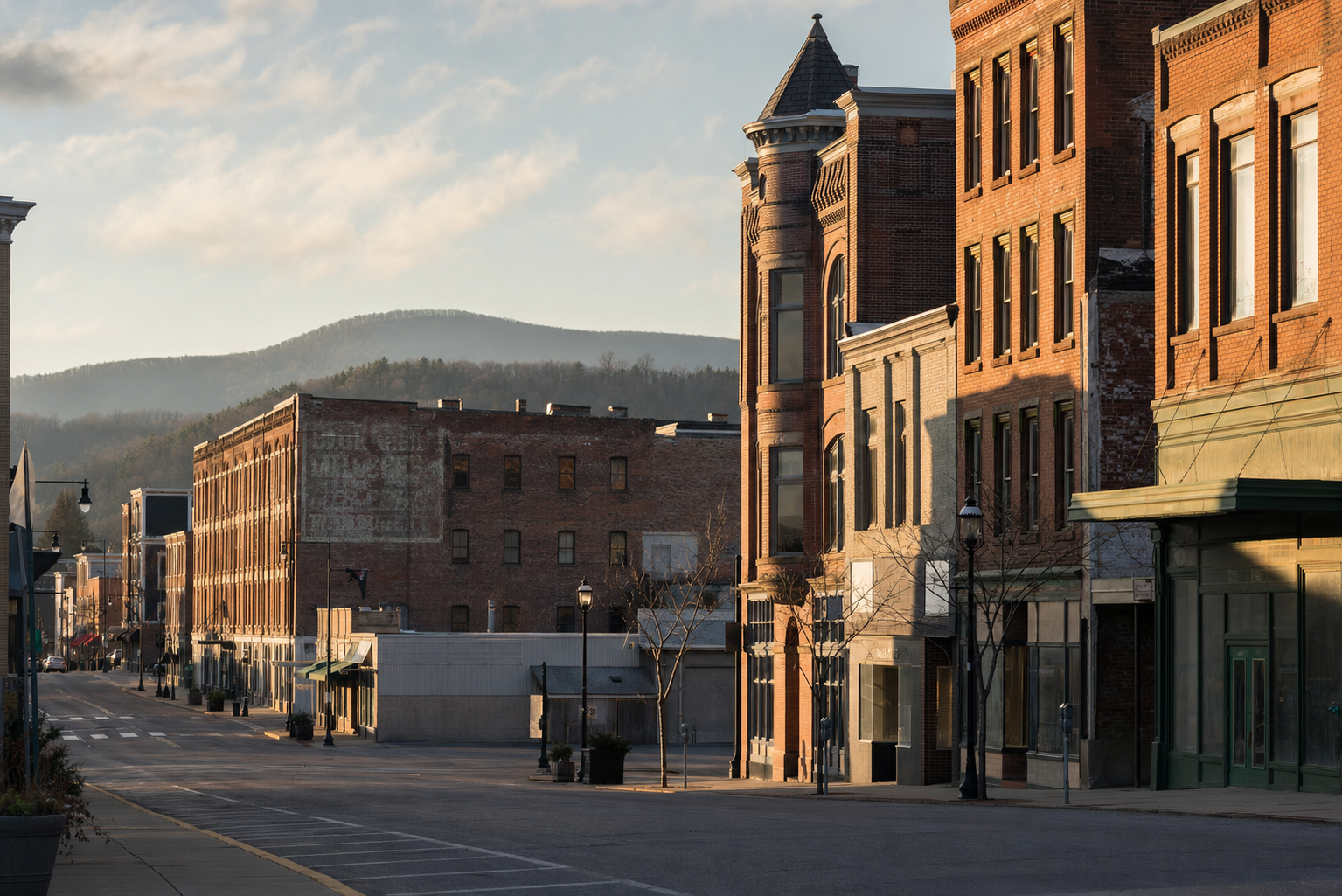
A Pennsylvania small-city main street in late afternoon light, with historic brick buildings, a faded ghost sign, and a mountain ridge visible in the distance.
What you can do

If you live, vote, or do business in Lycoming County — act now.

The next 12 months will set Pennsylvania’s data-center map for a decade. Bucks, Berks, and Beaver counties are already negotiating. Lycoming should not be the county that finds out too late.

Sources & further reading

Where these numbers come from.

Every claim on this site links to a primary source. Civic policy needs to survive citation.